Wednesday, January 30, 2013

Book Review: How to Be a Woman by Caitlin Moran

Caitlin Moran's How to Be a Woman is touted as the British version of Tina Fey's Bossypants, but it is far from the comedic masterpiece of Bossypants.  The difference is that while both Fey and Moran use their personal experiences to make a point about modern day feminism, the takeaway from Bossypants is, "That was a funny story, and I can't believe women are treated that way!"  Whereas the dialog after a How to Be a Woman diatribe is more likely, "I wish she had told more of the funny story instead of ranting about feminism for so long."  Not that I am against a feminist message.  What I am against is being hit over the head with a feminist message that the author is just going to rescind or revise a few pages later.

The book is a humorous read though.  Moran's stories show her quite unique upbringing in a poor British family, how she broke into music journalism, and other womanly experience such as having children.  There were many times where I could feel for the gawky young Caitlin as she tried to figure things out with very few resources.  The dialogs between her sister, who she seems to abhor in a violent way, but who she also seems to have a tiny softspot for, was the height of hilarity in the book.  It is certainly worth a read.  All of the stories were great, but the feminist messages between stories were a bit long-winded.

Book Review: Banishing Verona by Margot Livesey

Banishing Verona by Margot Livesey was a lyrical love story.  Zeke is a slightly odd London painter who is tricked into letting the very pregnant Verona spend the night at his clients' house.  They have an almost instant, yet tenuous, connection that is abruptly ended when Verona leaves after just two days.  The rest of the novel jumps back and forth from Zeke's and Verona's perspective.  Most of Verona's sections start prior in time to where the previous Zeke section began, giving the reader a jarring sense of catch-up.  Zeke is a bit strung along by Verona's harried plans and there are many missed connections, but the experience helps Zeke to grow as a person.

The fact that Zeke and Verona became so committed to each other after just one meeting is highly unrealistic, but I suppose romantic.  The characters are a bit quirky, which perhaps adds to the high level of commitment that develops at the drop of a hat.  What Livesey does best is character development.  She so discreetly shows the mind of a man living with Aspergers, although she never directly reveals this detail.  The narratives from his viewpoint are eye-opening as to what an adult in his situation might have to go through on a daily basis.  While it is just a classic romance with a quirky twist,  the prose is effortless and, therefore, a smooth and enjoyable read.  

Tuesday, November 27, 2012

San Juan (Not Puerto Rico)

In the Strait of Juan De Fuca between Vancouver Island and Washington are the San Juan Islands.  I had the pleasure of spending a long October weekend on the largest island, San Juan.  We arrived in Friday Harbor late and quickly found a decent place to eat.  Our hotel, The Earthbox Inn and Spa, was a 50s era motor lodge converted into a welcoming retreat and the only hotel on the island with an indoor pool.  Instead of the bright dingy colors of the 50s, our room was painted with cool earth tones, had wooden floors, and fresh white linens.  There was even a dog bed and bowls with complimentary dog bone waiting for Clara.

In the morning, we took a walk back to the harbor picking up coffee and breakfast sandwiches on the way.  After lovely massages at The Earthbox Spa, we explored the island by car.  Our first stop was the Lime Kiln Point State Park.  The park commemorates the lime mining done on the island for more than sixty years in the late nineteenth and early twentieth centuries.  The park has a lighthouse and a restored lime kiln.  It is also a great place to spot the area's resident orcas who had been seen two days before we got there; unfortunately, we did not see the whales.

After some brief hiking at the state park, we headed to both the American and British camps, both now run by the National Park Service.  The two camps, on either end of the island, where the setting of a land dispute.  After the Treaty of Oregon dictated that the 49th parallel would divide the United States and British controlled Canada, the San Juan Islands were claimed by both governments since the language of the treaty was interpreted differently by both parties.  The dispute was a quiet one for over ten years until it almost erupted into a war when an American shot a British pig he found in his garden. After months of build up, a peaceful resolution was agreed upon, and both countries remained on San Juan Island for another twelve years until another treaty gave the San Juan Islands to the United States. The park still has some original buildings.  The most odd, unrelated to the park at all, thing we saw there was a white goose grazing with a gaggle of Canada geese.


Later in the afternoon, we had a lovely snack of mussels and sweet potato fries on the deck at Downriggers before we headed to The Place Bar & Grill for dinner.  Both restaurants were delicious although the speed of the service at Downriggers left something to be desired.  The Place was a very small restaurant that specializes in regional fish and shellfish.  The meal was wonderful.  The ambiance, being such a small restaurant right on the harbor, was perfect for a quiet dinner.

Our last full day on San Juan was by far the best day of the trip.  First, I had a gooey cinnamon bun that was as big as my face from the Doctor's Office Cafe.  Later, we drove to the sculpture park.  The Westcott Bay Sculpture Park, unlike typical sculpture parks such as those outside the National Gallery or Hirshhorn Museum in Washington, DC, contains mostly sculptures that are for sale.  While some are quite lovely, others are overpriced and over thought.  It is bad enough when museums have "art" that anyone could make (sticks forming a ladder on a tree) but seeing the prices of that "art" is obscene.  Not to discount the many artists that have legitimate work in the garden.  I especially liked the easel with mirror that made the viewers the art.  The sculpture park was on the way to Roche Harbor where we would be kayaking.

Roche Harbor is actually a resort and marina but looks like an old-timey town.  It was also a lot like being in Disney World with a chapel, hotel, restaurants and shops.  It also has quite an extensive marina, giving us a view of how the boat set live.  The benefit of going kayaking out of peak season: we had the kayak guide all to ourselves.  Lucky for us our guide from San Juan Island Outfitters, who was also the company's co-owner, was immensely knowledgable on the ecology of the area.  We saw many harbor seals and learned that despite their appearances sunning together on rocks, they do not really like one another.  We also saw several bald eagles.  The most interesting thing was the bull kelp forest.  I didn't even know that there were "forests" in the ocean, but we rested on top of one.  It was a messy tangle of thick (at least 5 inches in diameter) bull kelp.  Each piece was attached to rocks many feet under the water.  Since we were just a party of three, we talked while we kayaked and were able to paddle all the way around Henry Island.  The pain of that much paddling in one afternoon was well worth the serenity of the place.

Finally, after a pizza dinner and live music at The Rumor Mill, we ended our trip.  The next morning we put the car in line at the ferry and wandered around town a bit more.  Since we were on San Juan Island celebrating our fifth wedding anniversary, the wood anniversary, we decided to buy a wooden bowl that was hand-carved by a local artist.  Much like the coastal areas of Maine, artists have flocked to the San Juan island and many shops sell their wares.  The ferry trip home was chilly, but we did see a whale and had a clear view to Mount Baker.


Thursday, November 8, 2012

Antietam in a Mini

A while ago, on the eve of the 150th anniversary of the battle, I visited Antietam in a mini.


While the battle may not be as famous as Gettysburg, the battlefield was a little easier to follow.  We went on the battlefield driving tour, in the mini, beginning at Dunker church and winding around the fields to bloody lane and the observation tower then Burnside Bridge and on to the Antietam National Cemetery.  And to the man who yelled that we were ignorant as we drove through his photo, that is what happens when you take a picture across a road.

It is fantastic that we can have momentous places preserved to such a degree.  The National Park Service has literally cleared the land so it would look much like it did in 1862 (Yay taxes!).  And the ranger discussion was phenomenal.  Also interesting is the fact that observation tower was built in the late 1800s; I suppose it shouldn't be surprising that those who lived through the events would want to revisit them but for some reason it was.  Later in the day, we saw mementos of many reunions in the early years after the war including buttons and banners at the Pry House Field Hospital Museum.  At the Pry House we were also questioned by some very eager reenactors who were in town for the anniversary.  We even went on to Harpers Ferry, which played a key role in the happenings at Antietam.  For some reason it had always been a desire of mine to go to Harper's Ferry, and it was worth it.  What a pleasant little town on a hill plus I had some delicious pumpkin ice cream there.  What made this trip most memorable was the mini (and the company of the mini's owner).  Here are more pictures of the mini at Antietam!


Monday, October 1, 2012

Mount Rainier

Mount Rainier is truly embedded in western Washington Culture (maybe in Washington culture in general, but I have not ventured to the east).  It is on the license plates, on signs on the military base, and on a clear day, you can see it every time you turn around.  In fact, I am looking at it right now out my living room window.  The difference between Mount Rainier and most other mountains I have seen around the world, is that Rainier sticks out so far above anything else.  Even huge mountains seem shorter when so closely surrounded by other mountains, but Rainier's loneliness in the skyline makes for true majesty.  In August, I took two trips to Rainer National Park.  Both were to the Sunrise Camp, and both were very different trips in terms of the mountain I saw (or didn't see being the more accurate way to put it).


Same scene, different days.


Trip One:  Our first stop was Federation Forest State Park to hike to the Hobbit House.  Judging by the amount of spider web I ate, this was not a terribly popular trail.  It was dense old wood and quite lovely.  We walked for some time along a river and saw many old growth trees.  The most interesting part of this forest were the giant stumps of fallen over trees that had sprouted new trees out of the roots.  It was as if a once earthbound piece of root felt the first ray of the sun's warmth and immediately perked up and said, "My turn!"  After about a mile, we reached the hobbit house, a cute little circle of tree stumps where people had set up the households of various gnomes and other small plastic creatures.  Cute, but hardly what I imagined from the description of a "residence worthy of Bilbo Baggins" as the Lonely Planet Pacific Northwest Trips guide billed it.  Maybe to truly get the spectacularity of the place, you have to be less than four feet tall.

On to Sunrise!  Despite the fact that the mountain was not out (see top picture), the place was phenomenal.  Sunrise is the highest point in the park one can drive to - 6,400 feet.  By the time we got to the parking lot, we were well above the tree line.  What is left are alpine meadows full of purple and red flowers - lupine (although not as tall as the lupine in Maine), mountain heather, and paintbrush.  We hiked along the ridge to Frozen Lake, one of many alpine lakes.  We even had to walk across some snow.  We didn't see any mountain goats, but it was a scene that could be imagined to be rife with goats.


Trip Two:  Just one week later, on a clearer day, my second trip to Sunrise was enlightening.  I was astounded as I got out of the car that all along our hike the previous week we were so close to the mountain and had no idea.  We thought we couldn't see Rainier from that location and were just seeing smaller mountains.  Turns out the "smaller mountains" were the bottom half of Rainier.  There looming large in front of me was the full mountain surrounded by a crisp blue backdrop.  On this trip, we did the same hike at Sunrise, but having skipped Federation Forest this time around, we had time to head farther east from Rainier to Tipsoo Lake, a large alpine lake that provides a great view of Rainier.  Tipsoo lake is crystal clear and closely surrounded by lush wildflowers.  The national park has done a lot to keep people on the trails here and help the wildflowers flourish.  Although, the many, many "stay on the trail" signs did not stop several people from taking pictures in the wildflowers.  One woman was even sitting in the flowers as her husband took her picture.  Honestly, I hope those people did not read English, otherwise they were some of the most ignorant people I have ever encountered.  We got there just in time to catch one picture of the mountain before the clouds rolled in.

Rainier from Lake Tipsoo
The time for visiting Sunrise has now passed for the year, the road is only open from July to September, and soon more and more of the national park will close for the winter.  Hopefully, we will visit the southern end of the park, parts of which stay open year-round, in the winter for some cross-country skiing and/or snowshoeing.


Monday, September 3, 2012

Back in Seattle Again

Definitely went to Seattle more times in the last two weeks than in three months of living in Washington.  Not really a downside of entertaining family.

While my husband and I usually snack our way through Pike Place Market, with my parents in tow, we decided to go for a sit down lunch.  The Pike Brewing Company had an immense selection of brews - I had a delicious seasonal honey ale - and delicious grub.  My bratwurst was delectable.


The ultimate purpose of this Seattle trip was to see the National Geographic King Tut exhibit - for the last time in North America (now maybe you feel you need to see it as urgently as all the advertising wants us to).  The exhibit was at the Pacific Science Center, which is just about the most 60s-tastic place I have ever seen.  Totally equipped with cement everything including arch work on some of the windows. 


The exhibit was awesome and quite dramatic.  I especially liked when prior to going into what was found in the tomb a loud TV told the story of a water boy discovering the top steps of the tomb then said loudly "Now enter Tutakamun's tomb!!!".  There was a lot of really awesome intricate gold and beadwork, but the most impressive thing was the wooden furniture - a bed and chair - that Tutankamun probably used in his life.  Three thousand plus year old wood!  It was also interesting that they plastered some of the gallery walls with photographs of what the rooms of the tomb actually looked like when Howard Carter found them.  It definitely gave a better sense of the mass of goods buried with the king.

Glad the advertising made me feel the urgency to see this exhibit!  


Tuesday, August 21, 2012

Chihuly Glass

Famous glass artist Dale Chihuly is from Tacoma; therefore, one of the coolest things about Tacoma is the amount of Chihuly glass on display in the city.  From the obvious art museums to the less obvious college libraries to the even less obvious bar, Chihuly's glass is everywhere.

The Chihuly walking tour is a great way to see Chuhuly's glass.  We tried to start at the Tacoma Art Museum, but since I do not do thorough research, they were closed.  What we did of the Chihuly walking tour ended up being a very filled afternoon anyway.

First stop was Union Station.  What once used to be the end of the transcontinental railroad is now a federal court house.  Chihuly has five works of art there.  The first is a colorful chandelier hanging from the dome of the building.  It brings to mind the contents of a candy shop artfully strung up from the ceiling.  The Monarch Window looked a little like a school of jelly fish swimming across the glass.  At first glance, all the sculptures appeared orange, but from different angles, blues, yellows, and reds came out.  From the outside, the sculptures took on even different shades.  Why monarchs?  When the trains go by the building, the glass sculptures shake, and if the light is hitting just right, orange light flickers across the floor.  We did not experience this first hand.

Chandelier
Monarch Window
The next artwork in Union Station are many of Chihuly's drawings.  They are not drawings for drawing's sake, but instead, drawings as preparation for making glass baskets.  I find glass making fascinating in that the artist does not do all the work him or herself but has many gaffers (people who blow the glass) to help.  Chihuly used these drawings to plan out color schemes, shapes, and to illustrate the movements the gaffers had to do to create the correct shape.  The next artwork, Reeds, was the simplest and most earthy Chihuly sculpture I have ever seen.  Two simple logs with red glass reeds sticking straight up.  It was simple, but beautiful, like a log on fire.  The final sculpture in Union Station was Ikebana Lakawana.  Lakawana for the name of the steel company whose name is stamped on the building's grand window frames and Ikebana for the long flowerlike glass sculptures.  This work was a beautiful mix of soft and hard because of the circular steel grid that all of the glass Ikebana are woven onto.


Basket Drawings
Ikebana Lakawana


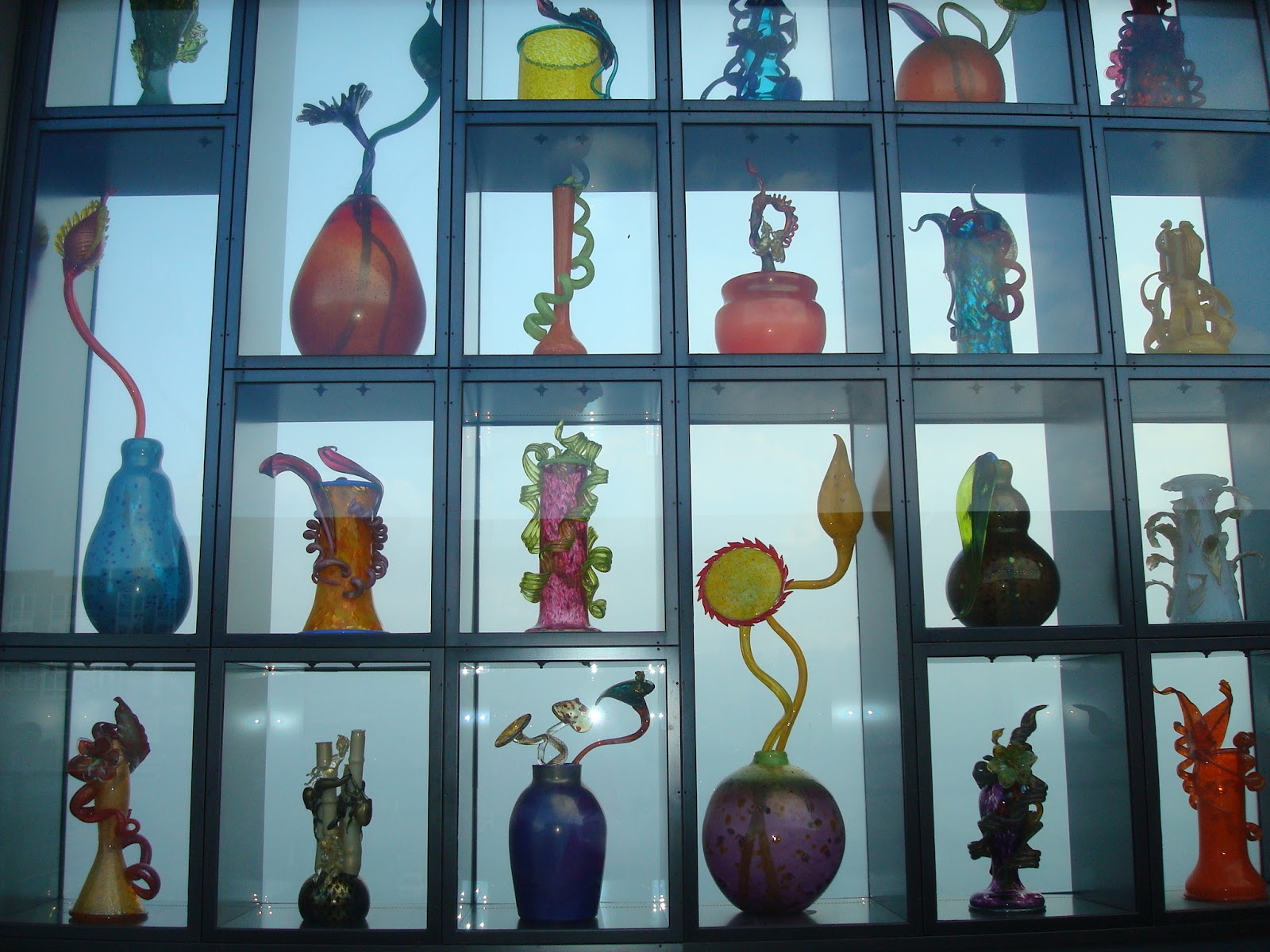
Next, we walked to the Bridge of Glass.  The bridge has three sections - Seaform Pavilion, Crystal Towers, and Venetian Wall.  The Seaform Pavilion is a ceiling filled with thousands of sea forms - think sea urchins and the like.  While this is at least the second time I have been to the Bridge of Glass, it is the first time I noticed the many putti or cherubs lingering throughout the ceiling of sea forms.    The second part of the bridge's artwork is two giant posts with what I can only think to describe as giant blue-green ice cubes.  They actually look a lot like rock candy.  The final artwork, is a wall of venetian vases, all different shapes with many Ikebana stemming out and around.

Seaform Pavilion
Crystal Tower
Venetian Wall

The next to last stop on the tour was the University of Washington Tacoma Library.  In the tower of the library, a room set up for quiet and group studying, is an enormous red chandelier - Chinook Red Chandelier.  It did not look very different in terms of structure from the chandelier in Union Station, but because it was all one deep red color, the physical structure of the piece was much more delineated.  

The final stop of the tour, was the Swiss Bar, one of my favorite places to get a drink in Tacoma.  The first time I went to the Swiss, I didn't even realize they had eight Chihuly sculptures!  Sitting above the South African mahogany bar (a gorgeous piece of work itself) are eight venetians, just like the giant vases on the Bridge of Glass.  The fact that this little bar in Tacoma has eight works of art from such a world-renowned sculptor is amazing in itself.  The best part is the story of how they got there.  While Chihuly and his team were working on the installation of the work in Union Station, they frequented the Swiss.  Out of the blue, Chihuly offered to bring in venetians to display above the bar.  And so it was.  And who doesn't like a tour that ends at a bar!!